
legg igjen en beskjed
Hvis du er interessert i produktene våre og ønsker å vite mer, kan du legge igjen en melding her, så svarer vi deg så snart som mulig.



RFID in the Chemical Industry: Improving Safety, Traceability, and Efficiency
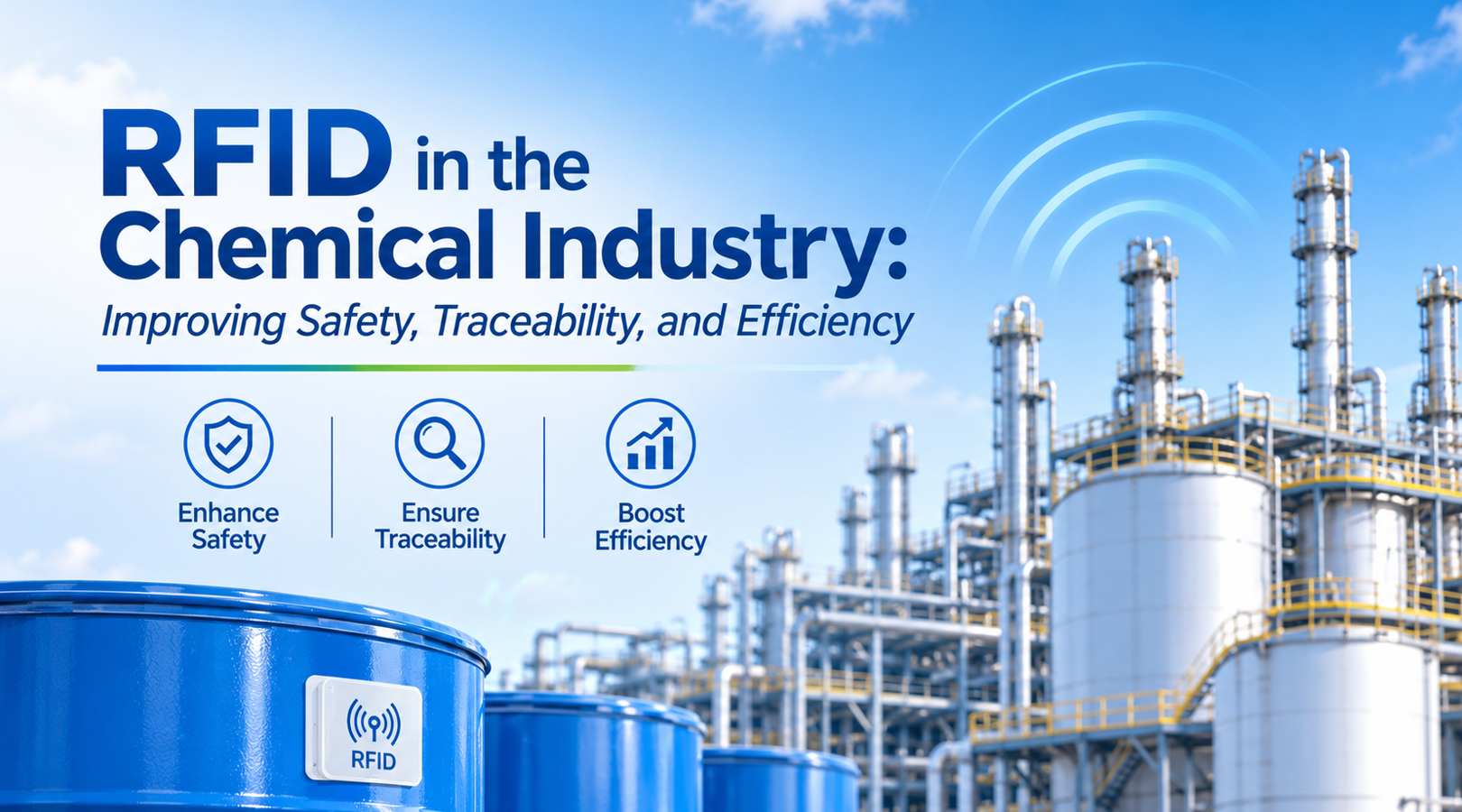
The chemical industry plays a critical role in manufacturing, energy, agriculture, pharmaceuticals, and numerous other sectors. However, chemical production and distribution involve complex processes, hazardous materials, strict regulatory requirements, and demanding inventory management tasks. From raw material storage to production, transportation, and final delivery, companies must maintain accurate records of chemical substances, containers, equipment, and personnel to ensure safe and efficient operations.
Traditional identification methods, such as barcodes, printed labels, and manual recordkeeping, can struggle in environments where chemicals are stored in large quantities, containers are frequently moved, and workers must operate under strict safety procedures. Labels may become damaged by moisture, chemicals, heat, or abrasion, while manual data entry can introduce errors and delay information updates.
Radio Frequency Identification (RFID) technology offers a more automated approach. By using radio waves to identify tagged objects, RFID systems can capture information without requiring direct visual contact between the reader and the tag. Depending on the system configuration, multiple tagged items can be identified in a single operation, helping chemical companies improve visibility across their facilities and supply chains.
Today, RFID is increasingly relevant to chemical inventory management, hazardous material tracking, production process monitoring, equipment maintenance, personnel access management, and logistics. When properly designed and integrated with existing management systems, RFID can help chemical enterprises strengthen traceability, reduce operational risks, and improve overall efficiency.
Chemical inventory management is one of the most practical applications of RFID technology. Chemical plants often handle a wide variety of raw materials, intermediates, additives, and finished products. These materials may be stored in drums, bottles, tanks, intermediate bulk containers (IBCs), or other specialized packaging.
Each container can be associated with an RFID tag containing a unique identifier linked to relevant information in a management database. This information may include the chemical name, batch number, supplier, production date, expiration date, storage location, and current inventory status.
When workers receive incoming materials, RFID readers can identify tagged containers and automatically record their arrival. Fixed readers installed at selected storage entrances can help capture material movements, while handheld RFID readers allow employees to conduct inventory checks without manually scanning every label.
For example, a chemical warehouse storing hundreds of drums may require substantial time to complete a manual inventory. With a suitable RFID system, workers can use handheld readers to identify multiple tagged containers and compare the collected data with inventory records. This can reduce repetitive scanning tasks and help identify missing, misplaced, or incorrectly recorded materials.
RFID can also support first-in, first-out (FIFO) inventory management. By linking tag identities to batch and date information, the system can help employees identify materials that should be used first or are approaching their expiration dates.
However, RFID does not automatically determine a chemical's identity from its physical properties. The tag must be correctly associated with the material record, and the database must be maintained accurately. These controls are essential for reliable inventory management.
The storage, handling, and transportation of hazardous chemicals require strict identification and traceability. Incorrectly identifying a substance, mixing incompatible materials, or sending a container to the wrong destination can create serious safety risks.
RFID provides an additional identification layer by linking each tagged container to its corresponding chemical records. When a container passes through a designated checkpoint, the system can record its identity, movement, and associated timestamp. Depending on the deployment, location information may be obtained from fixed readers, handheld devices, or a combination of RFID and other positioning technologies.
In a hazardous chemical warehouse, for example, RFID can help verify whether a container has entered the designated storage area. If a tagged container is detected at an unauthorized checkpoint, the management system can generate an alert for further investigation.
RFID can also support the traceability of chemical batches. From supplier delivery to warehouse storage, production consumption, and finished-product shipment, records can be connected through a centralized platform. If a quality issue or suspected contamination occurs, the company can use these records to identify potentially affected batches and review their movement history.
Nevertheless, RFID identification alone does not establish whether a chemical is safe to handle or whether a storage location is suitable. Chemical compatibility, temperature limits, ventilation requirements, and other safety conditions must be managed through appropriate procedures, sensors, and control systems.
Chemical manufacturing frequently involves multiple production stages, including raw material preparation, mixing, reaction, separation, filling, packaging, and quality inspection. Maintaining accurate material information throughout these processes is essential for product quality and production consistency.
RFID can connect raw material containers, reusable process vessels, production tools, and finished-product packages to digital manufacturing records. When a tagged container enters a designated production station, the system can retrieve its batch information and help verify whether it is assigned to the correct production order.
For example, a chemical manufacturer producing several formulations may need to ensure that the correct raw materials are delivered to each mixing area. RFID-based identification can help workers verify container identities against production instructions before materials are introduced into a process.
RFID can also support work-in-process tracking. Tagged containers or pallets can be identified at important production checkpoints, providing information about where materials are located and which processing stages have been completed.
When integrated with manufacturing execution systems (MES) or enterprise resource planning (ERP) platforms, RFID data can help improve production visibility, reduce manual recordkeeping, and support more accurate material consumption records.
In suitable applications, RFID can also help prevent unauthorized material substitutions by prompting verification when an unexpected container is detected. Such functions depend on correct tag associations, reliable reader coverage, and appropriate system rules. RFID should complement, rather than replace, process interlocks and other safety-critical controls.
Chemical containers are valuable operational assets. Drums, cylinders, IBCs, reusable totes, and specialized transport containers may circulate between suppliers, manufacturing facilities, warehouses, and customers. Without reliable identification, companies can lose track of containers, overlook returns, or struggle to determine their inspection status.
RFID tags provide a practical way to establish a digital identity for each reusable container. By reading the tag at filling stations, dispatch areas, receiving points, and return locations, companies can maintain a record of container movements and usage history.
For example, a chemical supplier operating a fleet of reusable IBCs can use RFID to record when each container is filled, dispatched, received by a customer, and returned for cleaning or inspection. The system can help identify overdue returns, reduce container losses, and improve asset utilization.
RFID records can also be linked to maintenance information, cleaning history, inspection dates, and permitted service conditions. Before a container is reused, employees can check whether the required inspection or cleaning process has been completed.
The tag itself must be selected according to the container material and operating environment. Chemical exposure, high temperatures, outdoor storage, and mechanical impacts may damage unsuitable tags. Metal containers may require specialized on-metal RFID tags or an appropriate mounting design.
For containers holding hazardous substances, RFID-based tracking should be combined with established cleaning, decontamination, inspection, and release procedures. A readable tag does not, by itself, prove that a container is clean or safe for reuse.
Chemical plants contain extensive equipment, including pumps, valves, pipelines, motors, tools, testing instruments, and maintenance components. Keeping accurate equipment records is essential for reducing downtime and supporting safe plant operation.
RFID can assign a unique identity to selected assets and connect them to maintenance schedules, inspection reports, installation details, and service histories. Maintenance personnel can use handheld readers to identify equipment and retrieve its associated records without relying solely on handwritten labels or manually entered asset numbers.
For example, during a scheduled inspection, a technician can read the RFID tag attached to a pump or maintenance tool. The maintenance platform can then display the equipment identifier, previous service records, and outstanding inspection tasks.
RFID can also help manage shared tools and portable instruments that move between workshops, laboratories, and production areas. By recording check-in and check-out events, companies can improve accountability and reduce the time spent locating equipment.
In large facilities, fixed readers may be installed at selected equipment storage areas or maintenance workshops to automate certain movement records. However, RFID location accuracy depends on reader placement and system design. A tag detected near a reader does not necessarily provide precise coordinates, so additional positioning technologies may be required for applications demanding continuous location tracking.
Personnel safety is a major concern in chemical facilities, particularly in areas containing toxic, corrosive, flammable, or otherwise hazardous substances. Companies must control access to restricted zones and ensure that workers follow established entry procedures.
RFID-enabled identification cards or badges can be integrated with access control systems to verify personnel credentials at designated entrances. The system can determine whether a worker is authorized to enter a specific area and record the access event.
In facilities with different hazard classifications, access rules can be configured according to job responsibilities, training records, or authorization levels. For instance, access to a restricted chemical storage zone may be limited to employees who have completed the required training and received appropriate permission.
RFID can also support personnel accountability by recording entry and exit events at selected locations. During an emergency, these records may provide useful information for incident management and personnel reconciliation.
However, RFID badges should not be treated as a complete personnel safety system. Access records may not reflect a person's exact real-time location, and badge sharing or missed reads can affect accuracy. Emergency response procedures, reliable communication systems, appropriate personal protective equipment, and dedicated personnel tracking solutions remain essential.
Chemical supply chains frequently involve multiple parties, including manufacturers, logistics providers, warehouses, distributors, and end users. Maintaining visibility across these stages can be difficult when each organization uses different recordkeeping systems.
RFID can help connect material identification with transportation and delivery records. Tags attached to containers, pallets, or transport units can be read at loading docks, warehouse gates, and receiving stations. These events can be used to record dispatch, transfer, and receipt activities.
For example, when a shipment leaves a chemical manufacturing facility, RFID readers can identify tagged containers and compare them with the shipping manifest. At the receiving warehouse, another reader can capture the arriving containers and help identify discrepancies between the expected and actual shipment.
This process can reduce manual scanning and improve the accuracy of shipment reconciliation. When integrated with warehouse management systems (WMS), transportation management systems (TMS), or ERP platforms, RFID data can provide a more consistent view of inventory throughout the supply chain.
RFID can also be combined with GPS, temperature sensors, humidity sensors, and other monitoring technologies. In this configuration, RFID identifies the container, while the additional technologies provide location or environmental measurements.
It is important to distinguish between identification and condition monitoring. A standard RFID tag does not automatically measure temperature, pressure, leakage, or chemical concentration. These capabilities require appropriate sensors and system integration.
RFID performance depends on the operating environment, tag design, reader configuration, and the characteristics of the materials being identified. Chemical facilities should evaluate these factors before selecting a system.
UHF RFID is often suitable for warehouse inventory, pallet identification, container tracking, and applications that benefit from relatively long read distances or the identification of multiple tags. However, liquids can absorb or detune radio-frequency signals, while metal surfaces can interfere with conventional tag antennas. Specialized tags and careful antenna placement may therefore be necessary.
HF RFID may be appropriate for certain close-range identification tasks, particularly where controlled reading distances are preferred. The best frequency depends on the application, required read range, tag density, and surrounding materials rather than on frequency alone.
Chemical environments also require attention to tag durability. Tags may need resistance to moisture, corrosive substances, ultraviolet exposure, vibration, or extreme temperatures. In potentially explosive atmospheres, all installed equipment must meet the applicable hazardous-area requirements. Standard RFID readers and tags should not be assumed suitable for such environments without appropriate certification and assessment.
A successful deployment should begin with a clearly defined use case, a site survey, and testing under actual operating conditions. Pilot projects can help evaluate read accuracy, interference, tag durability, integration costs, and the expected return on investment before a system is expanded across an entire facility.
RFID technology offers chemical companies a practical way to improve identification, traceability, inventory accuracy, asset management, and operational visibility. From tracking hazardous chemical containers to verifying production materials, managing reusable packaging, and recording logistics events, RFID can reduce dependence on manual processes and support more consistent information management.
Its value is greatest when RFID is integrated with existing business systems and supported by reliable data management, suitable hardware, and well-defined operating procedures. Chemical manufacturers must also account for liquids, metal surfaces, harsh environmental conditions, and hazardous-area requirements when designing their systems.
RFID is not a substitute for chemical safety engineering, regulatory compliance, or established risk-control procedures. Instead, it serves as a valuable digital identification and data collection layer that helps organizations make better-informed decisions.
As the chemical industry continues to adopt digital manufacturing, connected supply chains, and intelligent asset management, RFID will remain an important technology for building safer, more traceable, and more efficient industrial operations.

Detaljert informasjon og PDF

Kontakt for support via e-post.

Profesjonell teknisk veiledning.

Kontakt for support via e-post.



LENKE

YouTube

legg igjen en beskjed
Skann til Wechat/Whatsapp :



 IPv6 NETTVERK STØTTES